

How to Format SQL Online: Make Queries Easier to Read
How to Format SQL Online: Make Queries Easier to Read
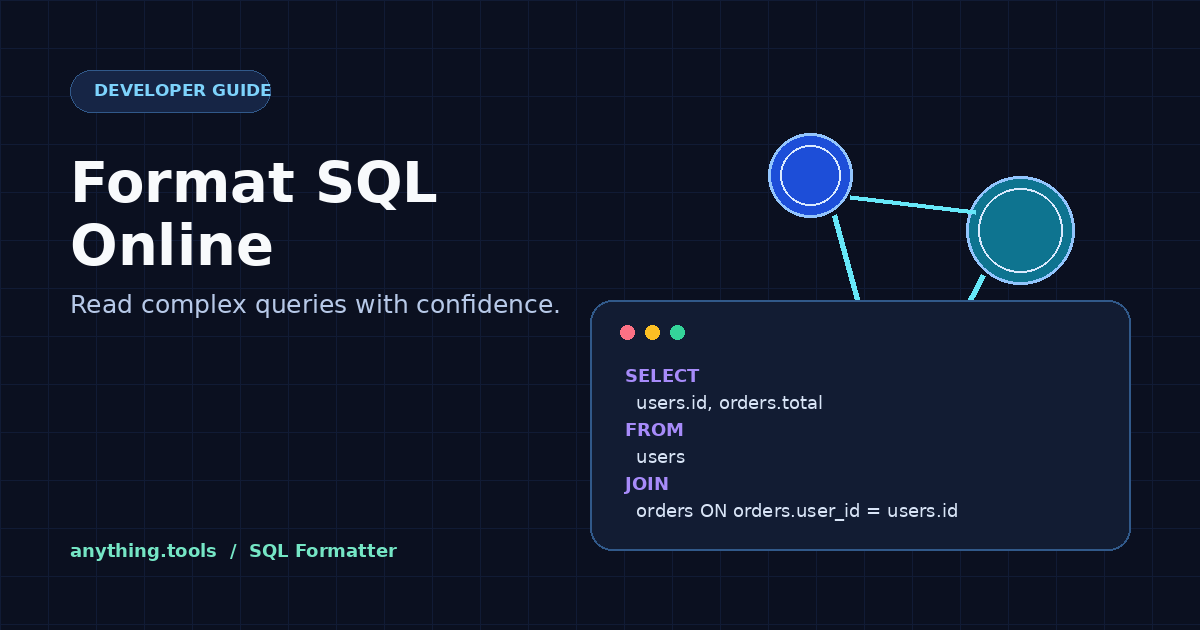
A long SQL statement can be correct and still be hard to review. When SELECT, joins, conditions, and nested expressions are squeezed onto one line, it is easy to miss a filter or misunderstand which table a column belongs to. Formatting makes the structure visible without changing the query’s intent.
What SQL formatting changes
A formatter applies consistent whitespace, indentation, and keyword casing. It can put each selected field on its own line, align JOIN clauses, and indent grouped conditions. It should not change table names, values, operators, or the database result. That distinction matters: formatting improves readability; it is not query optimization or validation.
A safe online workflow
- Copy the query from a trusted source.
- Paste it into the SQL Formatter.
- Review the formatted output before copying it anywhere else.
- Compare parameters, string literals, and
WHEREconditions with the original. - Run it only in the appropriate development or read-only environment.
For API payloads that sit beside a query, use the JSON Formatter as well. Keeping both the SQL and its sample data readable makes a code review much faster.
Read the query in logical blocks
After formatting, inspect the query block by block: SELECT answers what is returned; FROM and JOIN show where it comes from; WHERE limits rows; GROUP BY and HAVING summarize them; ORDER BY controls presentation. This order makes accidental broad queries easier to spot.
Common mistakes to avoid
Do not assume a neatly formatted query is safe to run. Formatting will not detect a missing tenant filter, a destructive statement, or an expensive join. Keep secrets out of pasted queries, replace production values with examples when sharing, and retain the original until you have confirmed that nothing meaningful changed.
Conclusion
Formatting is a small step with a large review benefit. Use an online SQL formatter before sharing a query, then verify its logic in the right database environment.
Related Posts
Convert Images to Base64: When It Helps and When It Hurts
Learn when Base64 image strings are useful for prototypes, emails, and small assets, plus when normal image files are better.

Wie man JWT-Token online decodiert
Erfahren Sie, wie Sie JSON Web Tokens (JWT) sicher und einfach in Ihrem Browser decodieren und überprüfen können.